INTERNATIONAL ONTOLOGY CONGRESS
Foundational Scientific Committee: A. Aspect (Paris); P. Aubenque (1929-2020, Paris); F. J. Ayala (1934–2023, California); J. Bouveresse (1940-2021, Paris); E. Chillida (1924–2002, San Sebastián); A. Grünbaum (1923-2018, Pittsburgh); W. Lamb (1913–2008, Arizona); T. Marco (Madrid); U. Moulines (Munich); I. Prigogine (1917–2003, Brussels); C. Rovelli (Marseille); H. Putnam (1926–2016, Harvard). Coordinator: Víctor Gomez Pin (Barcelona)
XVII Edition
SOLVAY 1927 - 2027
Centenary of the Colloquium that Challenged the View of Nature
Under the patronage of

Under the Honorary Presidency of
Pedro Miguel Echenique
Príncipe de Asturias Prize in Sciences and Max Planck Prize in Physics
24-28 OCTOBER 2027
University of the Basque Country, Faculty of Philosophy, San Sebastián, Spain
Chillida-Leku Museum
Donostia International Physics Center
SOME CONFIRMED SPEAKERS:
Pedro Miguel Echenique — Donostia International Physics Center (DIPC) / University of the Basque Country (UPV/EHU); Prince of Asturias Award for Scientific and Technical Research (1998), Max Planck Physics Prize (1998).
Albert Fert — Université Paris-Saclay / CNRS–Thales; Nobel Prize in Physics 2007
Ignacio Cirac — Max Planck Institute of Quantum Optics, Garching
Olival Freire — Universidade Federal da Bahia
David Z. Albert — Columbia University
Elise Crull — City College of New York, City University of New York
Jan Faye — University of Copenhagen
Sonia Contera — University of Oxford
Artur Ekert — University of Oxford
Tim Maudlin — New York University
Steen Rasmussen — University of Southern Denmark / Santa Fe Institute
Alberto Cordero — Queens College, City University of New York
Antonio Diéguez — Universidad de Málaga
Humberto Bustince — Universidad Pública de Navarra
Javier Echeverría —Jakiunde / Universidad del País Vasco - Euskal Herriko Unibertsitatea
Javier Tejada — Universitat de Barcelona
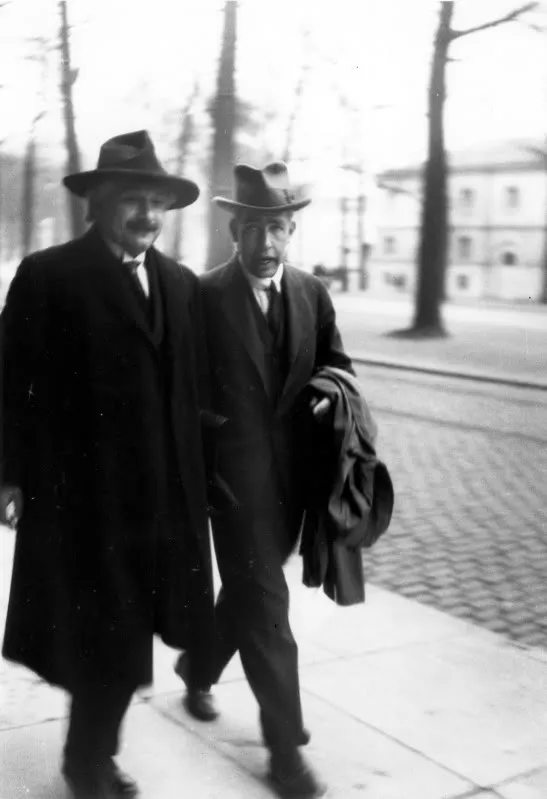
Solvay 1927
In 1903, the Belgian chemist Ernest Solvay sponsored the creation of a research center bearing his name at the University of Brussels. A few years later, in 1911, he initiated a series of periodic scientific meetings, the first of which—chaired by Hendrik A. Lorentz and devoted to The Theory of Radiation and Quanta—has come to be regarded as a landmark in the history of scientific conferences.
Among the Solvay Conferences, however, the meeting held in October 1927 stands out not only as a defining moment in the history of physics but also as the starting point of a far-reaching philosophical confrontation. Chaired once again by Lorentz, the 1927 colloquium brought together contributions of such depth and scope that the subsequent development of quantum physics throughout the twentieth and twenty-first centuries can be seen as already present there in germinal form.
Most notably, the conference witnessed the celebrated exchange between Albert Einstein and Niels Bohr, whose opposing views crystallized a fundamental debate on the interpretation of quantum mechanics. What was at stake was not merely a technical disagreement, but a profound divergence concerning the foundations of the natural order and the capacity of human reason to offer an adequate account of physical reality.
Subsequent milestones—such as Bell’s theorem and the experiments conducted by Alain Aspect and Anton Zeilinger—together with the ongoing proliferation of competing interpretations of quantum mechanics, continue to resonate with that original confrontation. In this sense, Solvay 1927 inaugurated a new “endless doctrinal battle” whose implications extend well beyond physics, shaping our broader philosophical image of nature itself.
One hundred years later, this enduring debate will be revisited by eminent scientists and philosophers at the 17th edition of the International Ontology Congress, which for more than thirty years, and under the patronage of UNESCO, has sought to re-examine the classic problems of ontology in the light of contemporary reflection.
In order to revisit the questions first crystallized at Solvay 1927 and to assess their continuing impact on both science and philosophy, the 17th International Ontology Congress will be structured around three thematic sections addressing the origins of the debate, its conceptual and technological developments, and the broader horizons opened by the quantum revolution.
1. Solvay 1927: The Foundational Debate on the Nature of Physical Reality
In the first decades of the twentieth century, the emergence of quantum theory challenged the conceptual framework that had shaped classical physics since the seventeenth century. The Fifth Solvay Conference, held in Brussels in October 1927 under the chairmanship of Hendrik A. Lorentz, brought together the principal architects of the new physics and became a defining moment in the history of science.
At the heart of the meeting stood the celebrated exchange between Albert Einstein and Niels Bohr, whose opposing views crystallized a fundamental philosophical problem: whether quantum mechanics provides a complete description of physical reality or merely a probabilistic account of observable phenomena. Their confrontation revealed deep disagreements concerning determinism, causality, locality, and the very meaning of physical explanation.
A century later, the questions raised in 1927 remain open. This section of the Congress will revisit the conceptual challenges articulated at the Solvay Conference and examine the diverse interpretations of quantum mechanics that emerged in response to them throughout the twentieth and twenty-first centuries.
2. From the Foundations of Quantum Theory to the Second Quantum Revolution
Following the debates initiated in the early development of quantum mechanics, the twentieth century witnessed an extraordinary effort to clarify its conceptual foundations. Among the most remarkable developments was the recognition of entanglement, which Erwin Schrödinger identified in 1935 as the characteristic trait of quantum mechanics.
Originally regarded as a paradoxical or even unacceptable feature of physical reality, entanglement later became central to the discussion of the completeness of quantum mechanics, particularly through the Einstein–Podolsky–Rosen argument, Bell’s theorem, and the experimental tests carried out in recent decades.
Today, entanglement lies at the heart of what is often called the Second Quantum Revolution, enabling new technologies such as quantum computation, quantum cryptography, and quantum communication. This section will explore the philosophical implications of these developments and assess how advances in quantum technologies reshape our understanding of physical reality.
3. Beyond the Quantum Revolution: New Conceptual Horizons for the View of Nature
The quantum revolution did not merely transform physics; it opened new conceptual spaces for reflection on the structure of reality and the limits of scientific knowledge. The interpretative debates surrounding quantum mechanics have influenced fields ranging from philosophy of science and metaphysics to information theory and cosmology.
As the implications of quantum theory continue to unfold, new questions arise concerning the ontology of physical systems, the role of information in nature, and the relationship between observation, reality, and explanation.
This section of the Congress will address the broader intellectual landscape that has emerged from the quantum revolution, examining how contemporary scientific and philosophical research continues to reshape our image of nature.
Special Session:
Nature and the Greeks: The Concept of Physis that Makes Physics Possible (A Philosophical Tribute to Erwin Schrödinger)
Associated with the celebrated equation describing the evolution of particles and with one of the most striking images in the history of science (an animal in a state of superposition between life and death), Schrödinger was also a distinctive explorer of the original conceptual framework in which some of the problems confronted by contemporary physics first emerged, for example, the problem of the ontological priority between the continuous and the discrete.
This led him to interrupt his specialized lectures at University College Dublin in order to trace an arc through time, beginning with quantum physics and ending with the Ionian thinkers—an oral reflection that gave rise to a small and illuminating text entitled Nature and the Greeks. As Roger Penrose noted in his preface to one of the editions of the work, "being concerned with the nature of reality and with the ways in which reality has been humanly perceived since antiquity," Schrödinger immersed himself in the writings of eminent scholars of ancient thought (Theodor Gompertz, John Burnet, Benjamin Farrington, etc.), making it clear that one of the major features distinguishing the thinkers whom Aristotle designated as ‘the physicists’ was that they advanced a concept of physis that makes physics possible.
And precisely because some of the ontological presuppositions and corollaries of this concept are called into question by quantum theory, our conference invites philosophers, philologists, and historians of Greek thought to assess the current state of the art regarding these origins of science
LOCATIONS
The OPENING and CLOSING events of the XVII International Ontology Congress 2027 will take place at Chillida-Leku Museum (Jauregi Bailara 66, Hernani).
The congress organizers will arrange transport to and from Chillida-Leku Museum.
The remaining of the sessions will take place at the University of the Basque Country, Facultad de Educación, Filosofía y Antropología (HEFA 1), Department of philosophy (Avenida de Tolosa, 70, 20018 San Sebastián, Spain).
LOCALIZACIÓN
Los actos de APERTURA y CLAUSURA del XVII Congreso Internacional de Ontología 2027 tendrán lugar en el Museo Chillida-Leku (Jauregi Bailara 66, Hernani).
La organización del congreso gestionará el transporte desde y hacia el Museo Chillida-Leku.
El resto de sesiones tendrán lugar en la Universidad del País Vasco, Facultad de Educación, Filosofía y Antropología (HEFA 1), Departamento de Filosofía (Avenida de Tolosa, 70, 20018 San Sebastián, España).